
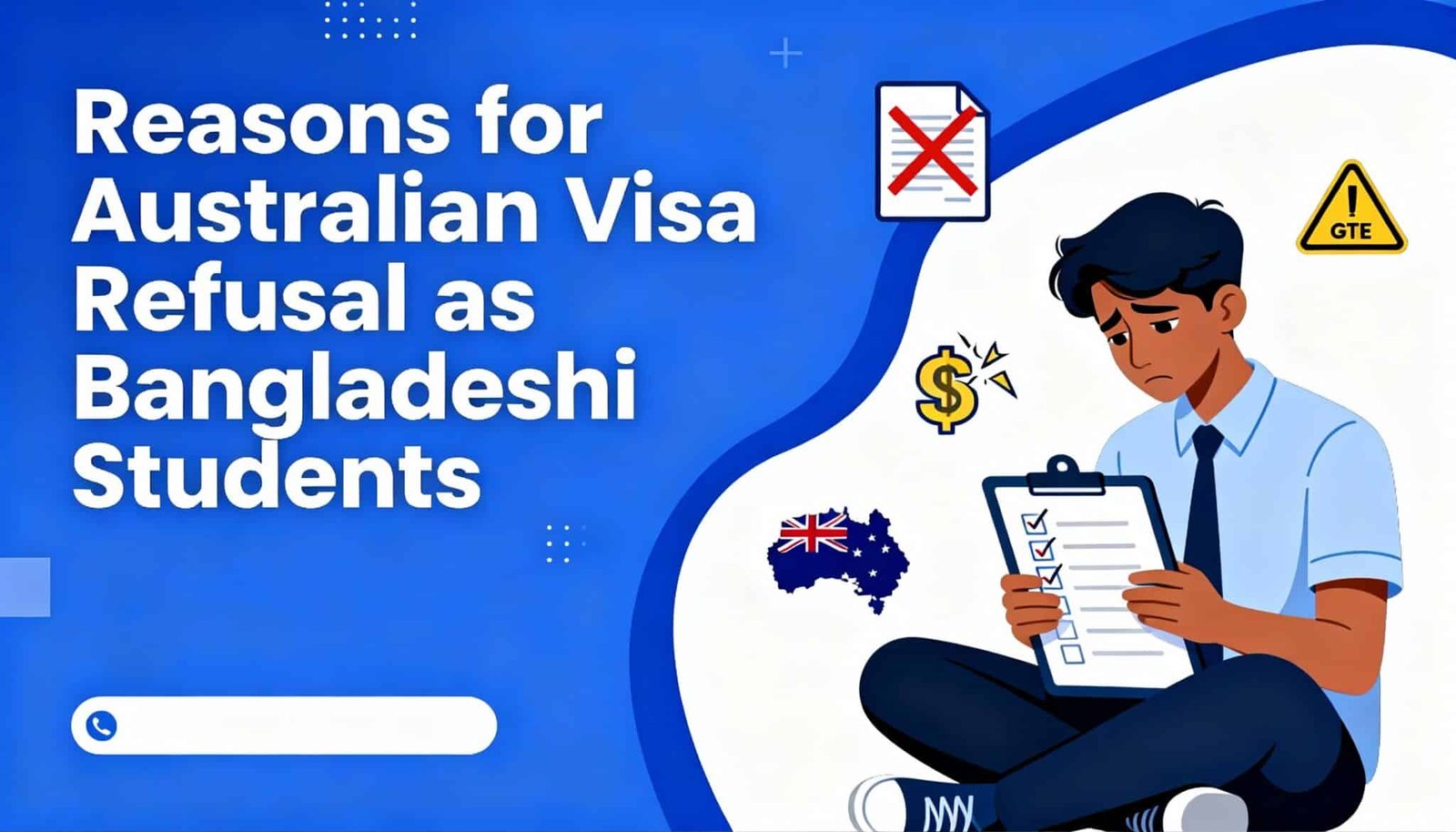
Reasons for Australian Visa Refusal as Bangladeshi Students 2026
Australia remains one of the most sought-after study destinations for Bangladeshi students. Every year, thousands of students apply to pursue higher studies, schooling, vocational education, and postgraduate degrees in Australia due to its world-class universities, multicultural environment, safe cities, and global career opportunities.
However, despite Australia’s popularity, many applications face setbacks because of the increasing number of Australian student visa refusals. Understanding the reasons for Australian visa refusal is essential before submitting your application. A single missing document, a weak Statement of Purpose (SOP), or inaccurate financials can lead to rejection—even if the applicant is academically strong.
Why Australia Is a Top Choice for Bangladeshi Students
Even though many applicants fear visa rejection, Australia continues to be one of the most attractive destinations for studying abroad.
Globally recognized universities
Australia is home to QS-ranked institutions like the University of Melbourne, Monash University, UNSW, and the University of Sydney.
Strong post-study work opportunities
Graduates can receive 2–6 years of post-study work visas depending on their degree and region.
High employability rates
Australian graduates work in fields like IT, engineering, health science, business, and hospitality with strong salaries.
Safe, inclusive, multicultural environment
Students from Bangladesh feel welcomed and supported.
Scholarship opportunities
International students can access a wide range of merit- and need-based scholarships.
To fully enjoy these benefits, applicants must avoid the common reasons for Australian visa refusal.
Top Reasons for Australian Visa Refusal
Below are the most frequent reasons for Australian visa refusal, as seen in recent GTE/GS assessments:
1. Insufficient Financial Evidence
One of the primary reasons for Australian visa refusal is failure to demonstrate the financial capacity required by Australian immigration authorities.
Students must show:
Tuition fees for at least one year.
Living expenses (~AUD 24,505 per year)
Travel expenses
Sponsor income and bank documents
If the funds are inconsistent, newly deposited, unverifiable, or poorly explained, the visa is likely to be refused.
2. Weak GTE (Genuine Temporary Entrant) or GS (Genuine Student) Statement
A poorly written GTE is among the strongest reasons for Australian visa refusal.
Common mistakes include:
Copy-paste content
Poor explanation of study gaps
Unclear future plans
Not linking the course to previous education
Lack of intention to return after study
A strong, personalized GTE is essential.
3. Unclear Academic Progression
If the course applied for does not logically align with the applicant’s background, it raises red flags.
For example:
A student with a BBA applying for a diploma in cookery without proper justification may face refusal.
4. Questionable English Proficiency
IELTS, PTE, or TOEFL scores that do not match university requirements can be one of the reasons for Australian visa refusal.
5. Inadequate or Wrong Documents
Missing documents like:
Academic transcripts
Passport pages
Bank statements
Sponsorship letters
SOP
can easily lead to refusal.
6. Incorrect Information or Misrepresentation
Any inconsistency in:
Application forms
Visa history
Travel history
Academic results
is considered misrepresentation—one of the most serious reasons for Australian visa refusal.
7. Gaps Without Explanation
Study or career gaps that are not supported with legitimate proof can cause visa denial.
8. Previous Visa Refusals From Other Countries
A history of visa refusal from Canada, the USA, the UK, or New Zealand must be explained clearly. Otherwise, it becomes one of the key reasons for Australian visa refusal.
9. Lack of Ties to Home Country
If immigration officers feel the student intends to migrate permanently, the application may be rejected.
10. Doubt About Returning After Study
Australia strictly checks whether a student truly intends to be a temporary entrant, even if PR is available after studies.
How to Avoid Australian Visa Refusal
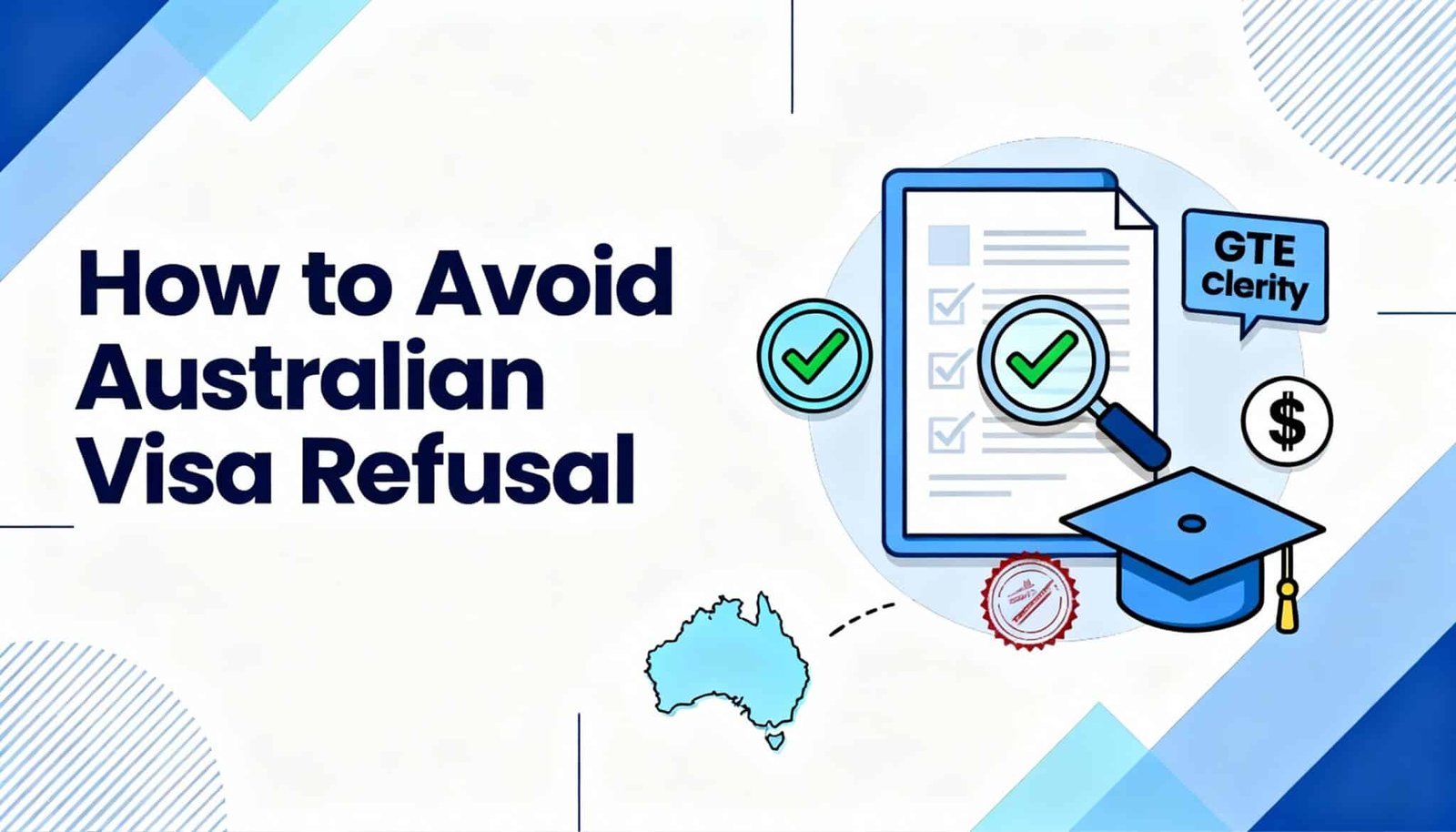
To increase your chances of approval:
- Maintain clean financial documents
- Write a strong, original GTE/GS
- Choose a relevant, progressive course
- Provide accurate, verified documentation
- Explain gaps properly
- Show family, financial, and social ties to Bangladesh
- Consult a reliable education consultancy for guidance
Avoiding the reasons for Australian visa refusal significantly increases approval rates.
Tuition Fees in Australia for Bangladeshi Students
| Degree Level | Tuition Fee per Year | BDT Equivalent |
|---|---|---|
| Diploma | AUD 10,000–18,000 | 7–13 lakh |
| Bachelor’s | AUD 22,000–35,000 | 16–25 lakh |
| Master’s | AUD 28,000–42,000 | 20–30 lakh |
| Doctorate | AUD 20,000–40,000 | 15–28 lakh |
Understanding tuition cost helps applicants prepare financial documents—another way to prevent visa refusal.
Living Costs in Australia
Australian immigration requires proof of living expenses:
| Category | Cost (Yearly) |
|---|---|
| Living | AUD 24,505 |
| Accommodation | AUD 10,000–20,000 |
| Food & Utilities | AUD 4,000–7,000 |
Better financial planning helps you avoid the most common reasons for Australian visa refusal.
Scholarships for Bangladeshi Students in Australia
Bangladeshi students can find scholarships in Australia through Australian government programs like the Australia Awards, university-specific scholarships based on merit, and private scholarships offered by organizations. Eligibility criteria typically include strong academic performance and English proficiency, with benefits like tuition, living expenses, and health insurance covered.
Australia Awards Scholarship (Fully Funded)
Destination Australia Scholarship
University of Sydney International Scholarship
Monash International Leadership Scholarship
RMIT International Excellence Scholarship
Scholarships also support stronger financial capacity—reducing the risk of visa refusal.
Schooling Opportunities in Australia
Australia offers diverse schooling from primary/secondary (public, private, specialized) through Vocational Education (TAFE/VET for skills) to Higher Education (Universities for degrees), with pathways like Foundation studies, English language courses, and flexible options (online, international campuses) to meet various goals, including career-focused training in high-demand fields like IT, Nursing, and Engineering, with strong support for international students.
Many families send their children for schooling due to Australia’s world-class curriculum.
| Level | Annual Fees |
|---|---|
| Primary School | AUD 10,000–16,000 |
| High School | AUD 12,000–20,000 |
Proper guardian arrangements are crucial; otherwise, schooling visas may also face refusal.
Higher Studies in Australia—Popular Courses
For higher studies in Australia, popular courses focus on high-demand sectors like IT & Computer Science, Engineering (especially Biomedical & Core), Health Sciences (Nursing, Psychology), Business & Management (MBA, Analytics, Accounting, Hospitality), and emerging fields like AI/Machine Learning, Biotechnology, and Renewable Energy, offering strong career prospects and migration pathways.
Students prefer fields with strong career demand, such as
Engineering
Nursing & Health Science
Business & Accounting
Information Technology
Cybersecurity
Data Science
Hospitality & Tourism
Construction Management
Choosing a relevant course decreases the reasons for Australian visa refusal significantly.
Job Opportunities in Australia for International Students
International students in Australia have great job prospects in high-demand sectors like hospitality, retail, IT, healthcare, and engineering, with many roles offering flexible hours, such as baristas, retail assistants, or admin staff, while graduate roles flourish in finance, tech, and education, often found on job sites like LinkedIn or university career portals. The key is balancing study with work, focusing on skills, and checking visa rules for legal work hours, with common roles including tutors, call center staff, delivery drivers, and on-campus roles.
Australia offers some of the best post-study work opportunities:
| Field | Expected Salary |
|---|---|
| IT & Cybersecurity | AUD 70,000–120,000 |
| Nursing & Health Sciences | AUD 65,000–100,000 |
| Engineering | AUD 70,000–130,000 |
| Accounting & Finance | AUD 60,000–90,000 |
Students who choose relevant degrees have a higher chance of visa success and employability.
Step-by-Step Visa Application Process for Australia
1. Receive an Offer Letter
2. Pay Tuition Fee Deposit
3. Complete OSHC Health Insurance
4. Prepare GTE/GS Statement
5. Submit Financial Documents
6. Upload Visa Application (Subclass 500)
7. Health Exam & Biometrics
8. Visa Decision
Each stage must be accurate to avoid the standard reasons for Australian visa refusal.
Final Thoughts: How to Successfully Get an Australian Student Visa
Receiving an Australian visa is not difficult if the application is truthful, consistent, and well-structured. Most Australian visa refusals happen due to avoidable mistakes—poor GTE statements, weak financials, wrong documents, or unexplained gaps.
When students follow the correct process with strong documentation, professional guidance, and genuine academic intention, approval becomes much easier.
Australia offers a life-changing opportunity for Bangladeshi students. Planning wisely can make your dream a reality.
Need Help Applying?
At Scholars Zone, we specialize in placing Bangladeshi students in affordable Australian universities that offer scholarships, PGWP benefits, and PR potential.


 WhatsApp Now!